
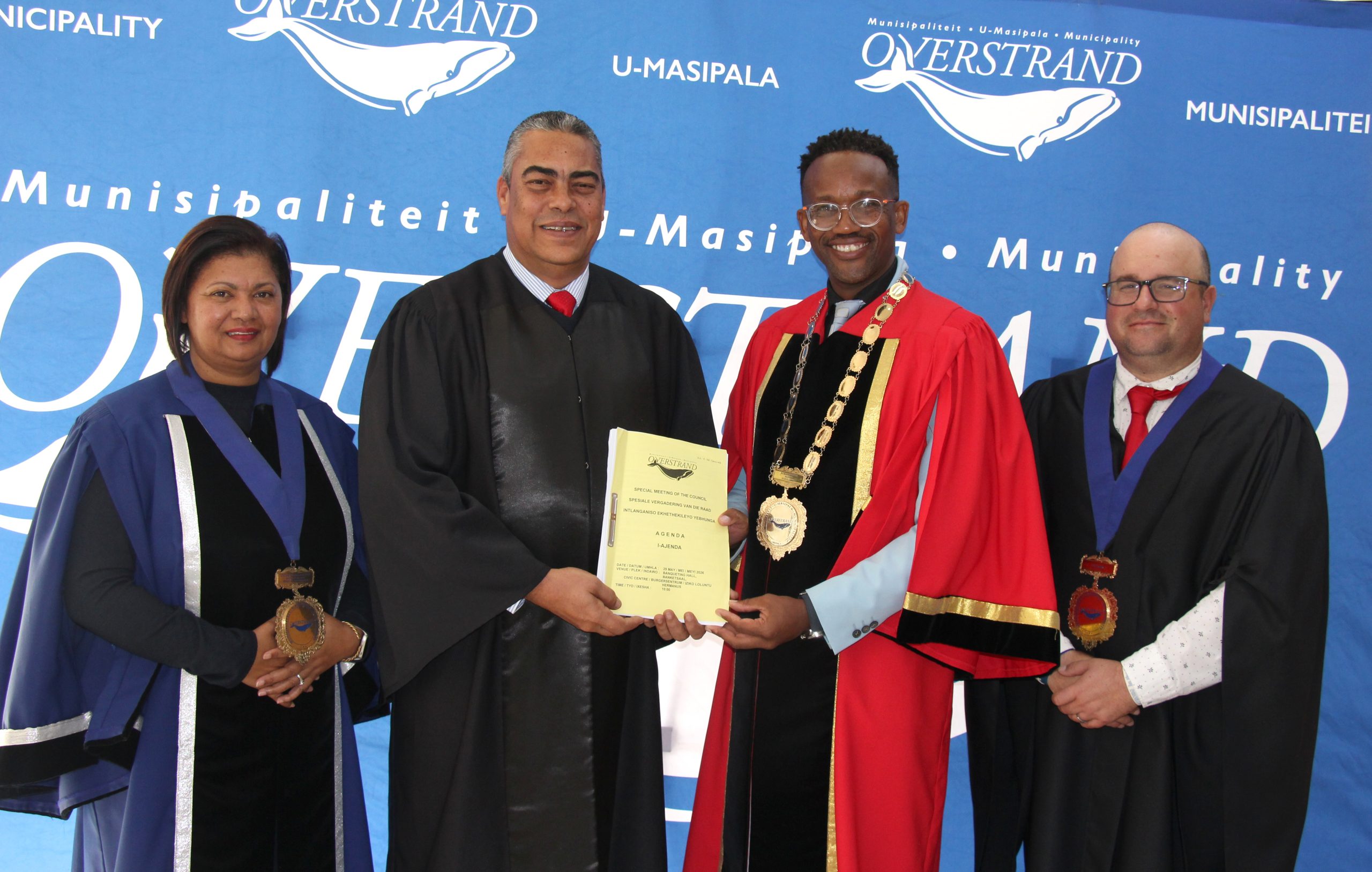
Earlier today, 29 May 2026, Executive Mayor Alderman Archie Klaas tabled the Overstrand Municipality’s 2026/27 Medium-Term Revenue and Expenditure Framework (MTREF) and delivered his Budget Speech in the Municipal Banqueting Hall in Hermanus. Following debate and deliberation, Council officially approved the budget for the upcoming financial year.
The discussion focused on issues affecting residents, including the municipality’s Cost of Supply Study, next year’s General Valuation Roll, the affordability of municipal services, and the financial pressures facing pensioners and households on fixed incomes.
Councillors also raised concerns about the impact of illegal electricity connections and cable theft, which can leave paying residents and neighbouring households without electricity.
Amid the debate, two clear messages emerged for the community.
- There is No Shame in applying for a Rates Rebate
With rising rates and looming property valuations threatening the wallets of pensioners who chose to retire in the Overstrand, Speaker Grant Cohen made a direct appeal: do not feel embarrassed to apply for the pensioner’s rebate.
There is absolutely no shame in accepting assistance for which you qualify. These relief measures exist to help ensure that pensioners and other vulnerable residents can continue to afford living in the Overstrand.
- Debunking the “Rich Subsidising the Poor” Myth
Deputy Mayor Elnora Gillion firmly corrected the misconception that wealthier residents are “paying for” lower-income households.
The grants, rebates and free basic services provided to registered indigent households do not come out of local ratepayers’ pockets. Instead, they are funded by national government through the Equitable Share allocation and other grant funding specifically intended to support vulnerable households.
The 2026/27 Budget: In Plain English
To keep things easy to understand, Mayor Klaas broke down the newly approved budget into three main sections:
- Expected Revenue (R2.092 billion): The money the municipality expects to collect from rates, service charges and other operating income, excluding capital grants.
- Operational Spending (R2.199 billion): The day-to-day cost of running the municipality, maintaining services and operating infrastructure. This amount also includes non-cash accounting items such as depreciation.
- Capital Budget (R242.5 million): Funding set aside specifically for infrastructure projects and long-term investments that improve service delivery.
HERE ARE SOME OF THE KEY HIGHLIGHTS FROM MAYOR KLAAS’ BUDGET SPEECH:
Managing Internal Spending: Staff Costs
A provision of R690.4 million (31.39% of the total operating budget) has been made for employee-related costs and Councillor remuneration, which remains within National Treasury’s benchmark of 25% to 40%.
While salaries are budgeted to increase by 4.75%, with an additional average 2.4% provided for notch increases, staff vacancies remain frozen and may only be filled following approval by the Municipal Manager.
The municipality has also introduced stricter controls on overtime expenditure. Increased overtime costs in recent years have largely been driven by emergency response operations, law enforcement activities, disaster management and the removal of illegal structures. Monthly monitoring and reporting mechanisms have been implemented to contain these costs.
The Cost of Services
Before determining tariffs, the municipality calculates the actual cost of providing each service to ensure long-term financial sustainability and fairness.
- Electricity: Costs R803.6 million to provide, with projected income of R839.8 million, resulting in a surplus margin of 4.32%.
- Water: Costs R211.4 million to provide, with projected income of R245.1 million, resulting in a surplus margin of 13.77%.
- Wastewater Management: Projected income of R165.5 million against expenditure of R154.5 million, resulting in a surplus margin of 6.63%, supported by operational efficiencies and investment in new sewerage tanker vehicles.
- Waste Management: Projected income of R149.3 million against expenditure of R133 million, resulting in a surplus margin of 10.9%.
Tariff Increases for 2026/27
- Property Rates: 5% increase. The residential cent-in-the-rand factor increases from 0.004988 to 0.005237.
- Water: 5% increase.
- Sewerage: 5% increase.
- Refuse Removal: 5% increase.
- Electricity: An average revenue increase of 8.5% applies as the municipality continues implementing cost-reflective tariffs. Following public participation, the proposed increase in capacity charges was reduced from 65% to 20%. Consumers may also migrate to the most suitable capacity tariff option to help manage their electricity costs.
- Sundry Tariffs: 5% increase, unless a cost-reflective or punitive tariff is required.
- Availability Charges: Maintained to cover the fixed costs of keeping municipal service networks available and operational throughout the year.
Support for Vulnerable Households
Council reaffirmed its commitment to protecting vulnerable residents through a range of relief measures, including:
- No property rates on residential properties valued below R350,000 (excluding vacant properties).
- A R15,000 rebate on the rateable value of all residential properties.
- An additional R35,000 rebate on improved residential properties.
- A further 20% rebate for qualifying residential properties used solely for residential purposes.
- Continued pensioner and indigent support funded through national government allocations.
Government Grants
The municipality will receive R304.8 million in Division of Revenue Act (DORA) allocations from National and Provincial Government during the 2026/27 financial year.
This is a decrease from the R368.4 million received during the previous financial year and highlights the need for prudent financial management and careful prioritisation of spending.
Investing in Infrastructure
The capital budget of R242.5 million will focus primarily on maintaining, upgrading and expanding critical municipal infrastructure.
The programme is funded through a combination of government capital transfers (R91.6 million), borrowing (R101.1 million) and internally generated funding from previous surpluses (R49.8 million).
A total of R166.9 million, representing 68.8% of the capital budget, has been allocated to basic services infrastructure:
- Water infrastructure: R74.8 million
- Electricity infrastructure: R65.1 million
- Wastewater infrastructure: R23.3 million
- Waste management infrastructure: R3.7 million
In addition, R80.7 million has been allocated over the three-year MTREF period for housing infrastructure projects.
Looking ahead
In closing, Mayor Klaas noted that while preparing the budget was a significant undertaking, the real challenge now lies in implementation.
He emphasised that service delivery depends not only on planning, but on diligent execution and a collective commitment to turning the budget into tangible improvements for communities across the Overstrand.
The municipality’s focus for the year ahead will be to maintain reliable services, invest in infrastructure, support vulnerable residents and ensure that every rand spent delivers value to the communities it serves.