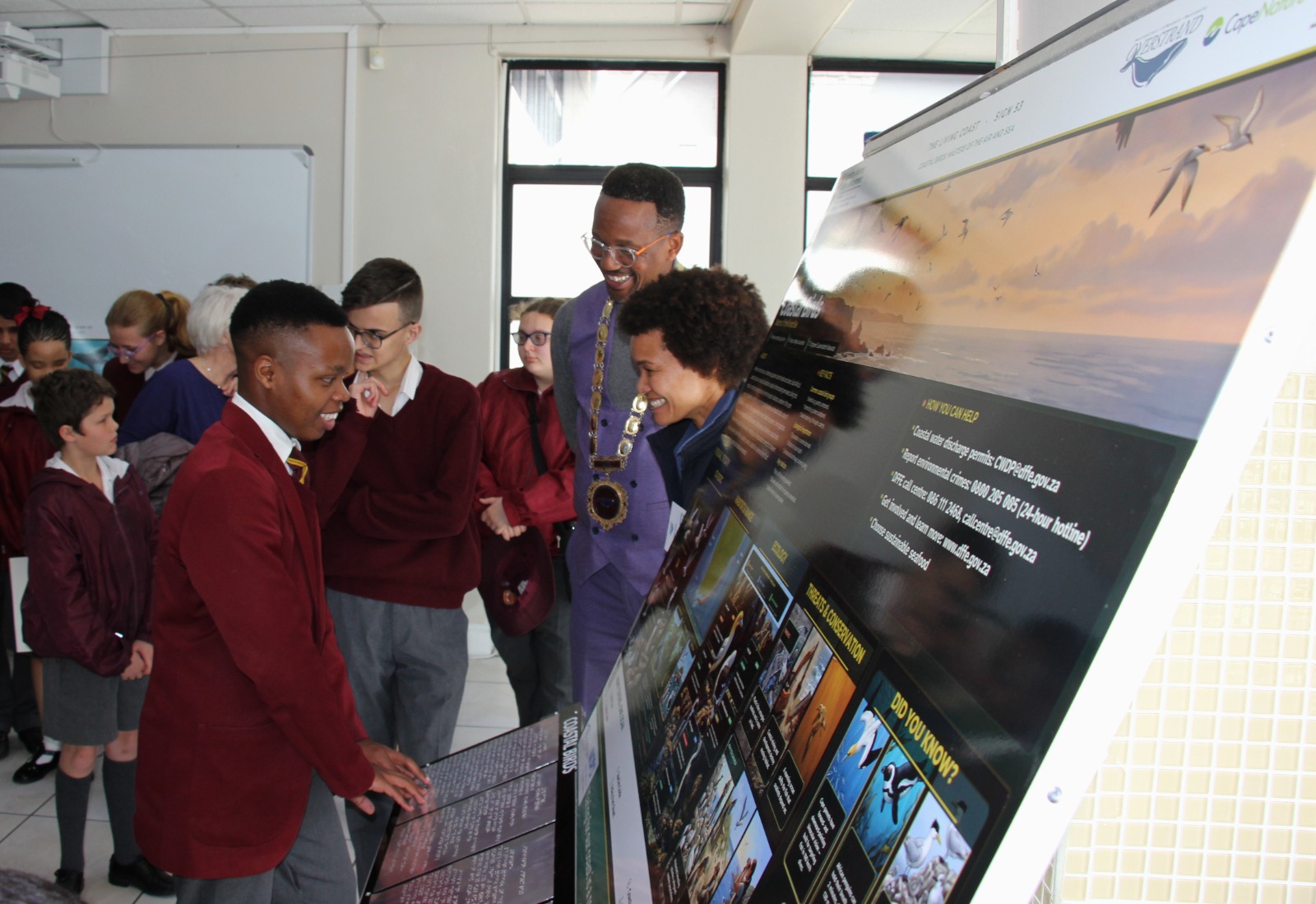
WESSA, The Wildlife and Environment Society of South Africa, together with government, conservation, accessibility and development partners, today unveiled five prototype Living Coast signs in Hermanus, at the Overstrand Municipality Auditorium and Banqueting Hall, marking the next phase in efforts to make South Africa’s coastline more inclusive and accessible. (Due to wet weather, the event could not be held at the Grotto East beach as intended).
The launch brought together officials, experts, environmentalists, researchers and youth from the Department of Forestry, Fisheries and the Environment (DFFE), Blind South Africa, CapeNature, Overstrand Municipality, UNICEF and the National Council of and for Persons with Disabilities (NCPD), with the Pioneer School for the Visually Impaired in Worcester opening the event with the South African Anthem.
In his welcome address, Overstrand Executive Mayor Alderman Archie Klaas noted that with the municipality located between the mountain and the sea, the environment is of great importance to the community. “Today is about more than recognising our natural environment. It is also about ensuring that everyone can experience and enjoy nature.”
For WESSA CEO Cindy-Lee Cloete, as the organisation marks its centenary this year, the Living Coast Prototype Signage initiative reflects its continued commitment to connecting people with nature and creating more inclusive pathways into environmental education and conservation. She noted that accessibility must be considered from the beginning of environmental education and conservation initiatives, rather than added at the end. “We need to listen to the people that experience the landscape in a lived reality every single day.
They need to be able to guide us to make sure that our intentions are good enough.”
From Braille to a new generation of coastal interpretation
The Living Coast Prototype Signage initiative builds on WESSA’s February 2026 unveiling of South Africa’s first Braille coastal environmental education signage at Blaauwberg Nature Reserve.
DFFE’s Ryan Peter described the initiative as a fundamental rethink of coastal interpretation rather than simply replacing weathered signage. “A sign only some of us can use is a sign with a fence around it.”
He said the ambition was for coastal information to be experienced through different senses and languages. “A sign, we decided, should not only be seen, but it should also be heard, it should be felt, and it should be understood in your own senses and in your own words.”
The new prototypes explore how Braille, sound, large-format text and digital information can work together to provide different ways of experiencing coastal environmental information.
Accessibility partners have contributed lived experience and technical expertise to the development of the signage, helping to ensure that the initiative responds to the needs of people who will use it. While UNICEF, through its focus on inclusive access for biodiversity learning for all, provides an opportunity to connect environmental education, accessibility and inclusive learning.
The Living Coast Prototype Signs are intended to provide a practical model for the future of coastal interpretation in South Africa, as it brings together environmental and accessibility objectives, recognising that inclusive access to information is an important part of environmental education.
Issued by:
WESSA Wildlife and Environment Society of South Africa, Department of Forestry, Fisheries and the Environment (DFFE) and Overstrand Municipality